The Half-Hour Hot Water Rule: A Calm Briefing on Italian Villa Bathrooms
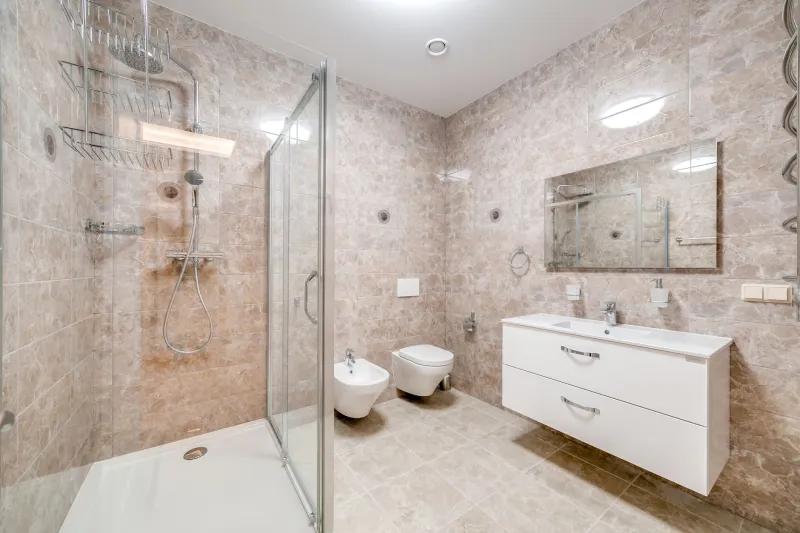
A British bathroom tends to be a boast disguised as a room: mains pressure, a combi boiler, a loo that clears in one flush and a shower you could use to strip paint. An Italian villa bathroom is a different contract. It works, usually beautifully, but on its own terms. The trick is to learn those terms before you arrive — and then to stop noticing them by Tuesday.
The tank is not a tap
Most villa hot water comes from a storage tank, often an electric or gas scaldabagno tucked into a cupboard or perched above the bathroom. It holds a fixed amount — perhaps 80 litres, perhaps 100 — and it heats up over time rather than endlessly. That is why the first shower after a day at the beach can be magnificent and the fourth can be lukewarm and slightly apologetic.
Ask the owner how big the tank is and how long it takes to recover. The answer is often half an hour to an hour. Plan accordingly: stagger showers rather than queueing for them all at 7pm, and save the deep hair-wash for a moment when nobody else is mid-rinse. If there is a bath, treat it as a luxury rather than a default. A bath plus four showers is a big ask of a small tank.
Pressure, and the shower that shrugs
Low water pressure is common in rural Italy, especially where the supply feeds several properties or climbs a hill to reach the villa. The shower may be a modest wall-mounted affair with a spray that suggests enthusiasm rather than delivers it. This is not a sign that something is broken; it is a sign that you are in the countryside.
Check before booking whether there is a pressure pump, and whether the shower is in the main bathroom or an en-suite. Some villas have one strong shower and one polite one. That is useful information when three generations are sharing the place. Bring your own shower cap if you use one — they are rarely provided — but leave the industrial shower head at home. It will not fit, and the owner will not thank you.
What goes down the loo, and what absolutely does not
In towns, the sewer does what sewers do. In the countryside, many villas run on a fossa settica — a septic tank — and that changes the rules. Wet wipes, kitchen roll, cotton pads, tampons and anything labelled 'flushable' by a optimistic manufacturer should go in the bin. The bin is not a suggestion. It is the difference between a normal week and a very expensive visit from a tanker.
Italian plumbing is often narrower than UK plumbing, too. A single flush may not clear everything, and repeated vigorous flushing can be worse than a pause and a second attempt. If something does go wrong, tell the owner or caretaker straight away. They would rather hear about a slow drain on Monday than a blocked system on Friday.
The bidet: not a footbath, not a mystery
British guests tend to fall into two camps: those who ignore the bidet entirely and those who use it as a mop sink. Neither is ideal. A bidet is for washing, and the etiquette is simple enough: sit facing the taps, use the small towel provided for the bidet rather than the bath towel, and keep it brief. It is also excellent for rinsing sandy feet after the beach, provided you rinse the basin afterwards.
Do not use it to wash dishes, laundry or a dog. Do not stand in it. And do not unscrew anything to see how it works. Curiosity is admirable; plumbing is not a puzzle box.
Hard water, soft expectations
Much of Italy has hard water, which means limescale on the shower screen, a white film on the taps and a kettle that looks like a geological exhibit. This is normal. A bottle of white vinegar from the local supermarket will deal with most of it, and a squeegee after showering helps the screen stay clear.
What you should not do is attack the fittings with an abrasive pad. Italian bathroom fixtures can be stylish and delicate, and a scratched chrome mixer tap is a much bigger deal than a bit of scale. If the shower head has clogged nozzles, mention it rather than dismantling it.
The drain that sulks
Four people washing long hair in a villa shower is a lot to ask of a small drain. Add sand, sunscreen and the occasional dollop of conditioner, and the trap will eventually complain. Pack a travel hair catcher — the flat silicone kind takes up no space — and empty it after each shower. It is a small habit that prevents a very unattractive paddle pool at your feet.
Do not pour cooking oil down the sink, and do not use chemical drain cleaner unless the owner has approved it. Rural systems can be sensitive, and a caustic product may do more harm than good. A sink strainer in the kitchen is also worth packing if you plan to cook properly.
Ask before you book
A short message to the owner before you commit will save a week of small irritations. Ask how the hot water is produced and how many bathrooms share it. Ask whether the property is on mains drainage or a septic tank. Ask if there is a pressure pump, and whether the shower is fixed or handheld. Ask if there is a washing machine — and, if so, whether it can run while someone is showering. These are not fussy questions. They are the sort of thing a good owner answers in two lines.
The golden rule: report, don't endure
If the shower runs cold, the drain gurgles or the loo needs two flushes, say something on day one. Owners and caretakers are used to it, and most would rather fix a small thing than have a guest spend seven nights composing a review. A villa bathroom is not a hotel bathroom, and that is part of its charm. Treat it as a system with quirks rather than a machine that has failed you, and you will spend far more time thinking about the view than the water pressure.