Four Bins and a Learning Curve: Waste Sorting at Your Italian Villa
You can spend weeks choosing the villa, months imagining the terrace, and precisely four minutes thinking about the bins. Then you arrive, open the kitchen cupboard, and find five containers in colours that mean nothing to you and a laminated calendar written in a dialect of Italian that seems to have been designed as a puzzle.
Welcome to the least glamorous, most unavoidable part of an Italian villa holiday. Italy sorts its waste with a seriousness that makes the UK's fortnightly kerbside ritual look almost casual. Get it right and nobody notices. Get it wrong and you'll either find a note taped to the bin lid or a fine quietly folded into your departure paperwork.
Why It Matters More Than You Think
In Britain, we're used to putting everything into one or two bins and letting the council sort out the rest. In Italy, responsibility sits firmly with the household — and for a week or two, that household is you. Local councils, not a national body, set the rules, which is why your friend's villa in Puglia had a completely different system from the one you've booked near Lake Garda.
The stakes are modest but real. Contamination — a stray plastic bag in with the food waste, a greasy pizza box in with the paper — can mean an entire bin is refused. In smaller towns, collection is often doorstep and very visible, so a poorly sorted bin is a public statement about the guests in the big house up the hill.
The Cast of Characters
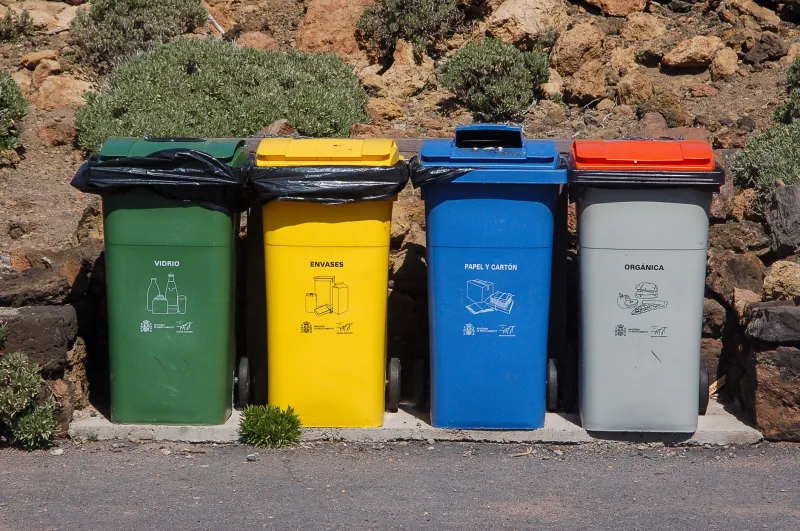
Names vary by region, but the core categories are fairly consistent.
Organico / umido — food waste. Usually brown, sometimes green, and collected more often than anything else, especially in summer. This is the bin that smells, so it's the one to keep on top of. Use the compostable bags provided, not a standard plastic carrier bag.
Carta e cartone — paper and cardboard. Often blue. Flatten boxes; don't stuff a wine carton with plastic wrapping and hope for the best.
Plastica e metalli — plastic and metals, frequently together in yellow. Rinse anything that held food. A yoghurt pot with a centimetre of residue is a small act of aggression against whoever processes it.
Vetro — glass. Green in many places, sometimes collected separately, sometimes taken to a communal bell-shaped container at the end of the street. Ask before you assume the empty olive oil bottle goes in with the plastic.
Indifferenziato / secco residuo — the general waste, usually grey. This is the smallest bin and the last resort. Nappies, used plasters, the broken flip-flop.
Reading the Calendar Without a Translator
Collection schedules are usually a grid with symbols, colours and the occasional public holiday asterisk. Photograph it on day one and put it somewhere you'll actually see it — a phone lock screen works well. Many villas also have a printed sheet in English, but don't count on it.
In high summer, organico is often collected daily or every other day, while general waste might be once a week. Bins generally go out the evening before and come back in the following morning. Leaving them on the street for two days is the sort of thing that gets a mention.
Some properties have communal bins with keys, and some have individual containers with your apartment number on them. Ask which is which before you start wheeling things around.
Five Questions to Ask Before You Book
- Which bins are on site, and where are they kept?
- Is there a printed collection calendar, and does it change in August?
- Does glass go in a bin at the villa or to a communal container nearby?
- Are compostable bags supplied, or should we buy them?
- What's the departure-day routine for rubbish?
That last one matters more than it sounds. Many villas ask guests to take general waste to a collection point on the way out, and turning up at the wrong one with a boot full of bin bags is not the relaxing final morning you imagined.
A Few Habits That Save Fuss
Keep a small caddy on the counter for food waste and empty it every evening. Rinse containers as you go rather than letting them accumulate. Don't put recyclables inside plastic bags — a very British habit that causes no end of confusion. Flatten cardboard. And if you're unsure whether something is recyclable, the general waste bin is the honest answer; contamination is worse than volume.
The one thing you should never do is leave rubbish sitting outside the villa in bags. Wildlife in rural Italy is resourceful, and a fox or a stray cat can undo an hour of careful sorting in about ninety seconds.
Nobody Books a Holiday for the Bins
But the bins are part of the rhythm of the place, and once you've cracked them, the week runs smoother. You stop noticing the five containers, the nightly walk to the collection point becomes a small ritual, and the neighbour who was eyeing your recycling on Tuesday gives you a nod by Friday.
It won't make the highlights reel. But a villa holiday is made of small, ordinary things done with a bit of care — and knowing where the pizza box goes is as good a place as any to start.