The Festival Next Door: Planning a Villa Week Around an Italian Sagra
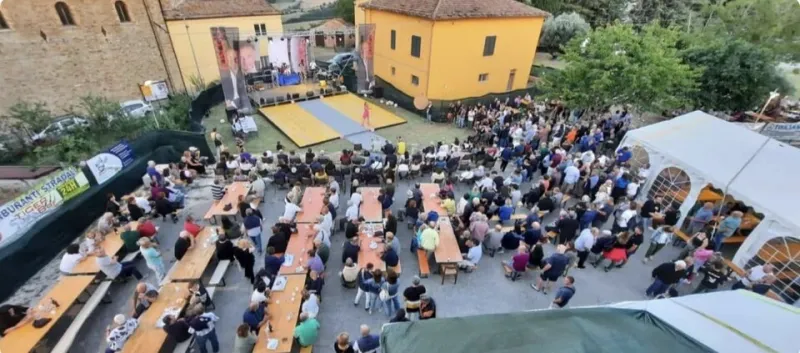
Photo: SamirSimonciniSforza, CC0, via Wikimedia Commons
The first sign is usually a hand-written notice taped to the bakery door. Then bunting appears across the lane, a stage rises in the piazza, and by Friday evening the whole village smells of frying dough and slow-cooked meat. You have stumbled into a sagra, and your villa week has just acquired a plot.
A sagra is a local food festival, often run by volunteers from the village's Pro Loco association. It might celebrate a particular pasta, a chestnut, a wine, a cheese, a saint or simply the fact that it is summer. Some are tiny. Some fill the square for three nights. All of them are a far better introduction to Italy than another museum queue.
What a sagra is — and what it isn't
A sagra is not a curated tourist event with a website, a VIP area and a branded tote bag. It is a community meal with music. You will queue at a counter, buy tokens or pay cash, collect a paper plate of something local, and find a seat at a long table beside people who have lived in the village for decades. There may be a band. There may be a raffle. There may be a procession, a fireworks display or a greased pole. It is not always polished, but it is rarely dull.
It helps to know the vocabulary. A sagra is usually about food. A festa patronale is a patron-saint celebration, often with a procession and fireworks. A fiera is a fair, sometimes agricultural, sometimes commercial. A mercatino is a small market. If you are searching online, try all four words with the village name, and add the year you are travelling.
Find the dates before you book
Sagra dates move. They are set by local committees, not by a national calendar, and a festival that ran in the second week of August last year may shift this year. Do not rely on an old blog post or a tourism leaflet you picked up in 2019. Check the comune's events page, the Pro Loco's social media, local posters and the villa owner. If you are travelling in 2026, search for the 2026 dates specifically.
Ask the owner a direct question: are there any sagre, feste or fairs in the village during our week? A good owner will know. They may even send a photo of the poster. If the village has a patron-saint day, ask whether the roads close and whether fireworks are involved. That is not small talk. It affects parking, sleep and whether you can get the car out for a day trip.
Choose a villa within walking distance
The best sagra experience is the one you can walk to. Look for a villa or apartment within 15 to 20 minutes on foot of the village centre, ideally on a route with street lighting and a pavement. That way you can have a glass of local wine without negotiating dark lanes in the car. It also means you can drift home when the children flag, rather than waiting for the whole festival to end.
Check the terrain. A dot on the map can hide a steep hill, a flight of steps or an unlit shortcut. Use Street View and ask the owner about the walk. If you are travelling with grandparents or very small children, a shorter walk matters more than a bigger pool.
And be honest about noise. A villa described as “peaceful” may still hear the bass from the piazza until midnight. That is part of the fun if you are joining in. It is less fun if you have booked a quiet week and a toddler who wakes at five. Ask where the festival takes place and which bedrooms face it.
Plan around road closures and noise
Village festivals close roads. Processions, fireworks and outdoor tables all need space, and the car may not be able to reach the villa on the final evening. Ask the owner which streets close and when. If you are arriving on festival day, plan to park outside the closed area and walk in with your bags. Do not assume you can squeeze through just before the procession starts.
Fireworks are usually late and loud. If your family are light sleepers, pack earplugs, choose a villa with good shutters and air conditioning, and treat the fireworks as a planned event rather than a rude surprise. If you have a dog, check before booking; many Italian festivals are not dog-friendly in the middle of the crowd.
Build the week around the festival, not on top of it
A sagra is an evening event, so keep the day gentle. Go to the market in the morning, spend the afternoon by the pool or at the beach, then head into the village when the tables are being wiped down and the first plates are coming out. Arrive early enough to eat before the queues, but late enough for the atmosphere to have warmed up.
Do not schedule a long day trip that returns at 10pm on festival night. You will be tired, the roads will be closed and the best of the evening will already be gone. Instead, give the sagra its own day. Let it be the reason you stay close to home.
The local experience bit
Go with curiosity rather than a checklist. Try the dish the village is proud of, even if it sounds plain. Sit at a communal table. Let the children play with local kids who do not share a language but do share a football. Learn the words for “please” and “thank you” and “what is that?”. Carry some cash, because smaller sagre may not take cards, and keep an eye on the token system if there is one.
This is not a theme-park version of Italy. It is a village raising money for the church roof or the local football team, and you are a guest at the table. Behave accordingly, and you will be treated generously.
A simple sagra-week checklist
- Confirm 2026 dates with the comune, the Pro Loco and the villa owner.
- Choose a villa within walking distance of the village centre if possible.
- Ask about road closures, fireworks and noise before you book.
- Plan arrival day around the festival, not through it.
- Keep one evening free for the sagra and do not book a late restaurant.
- Carry cash, a torch for the walk home and earplugs if you need them.
- Check whether the festival is food-focused, religious, agricultural or all three.
- Let the evening be slow. The point is not to tick off an event. It is to eat with a village.